Noorani Qaida
نورانی قاعدہ
A step-by-step foundation in Arabic letters, sounds, joining, vowels and correct pronunciation for children and complete beginners.
Learn Noorani Qaida, Nazra, Tajweed, Makharij and Hifz through live one-to-one lessons. Request a male or female Quran teacher for a child, adult or complete beginner, with English, Urdu or Arabic support.
بچوں اور بڑوں کے لیے انفرادی آن لائن قرآن کلاسز — نورانی قاعدہ، ناظرہ، تجوید، مخارج اور حفظ، مناسب وقت اور واضح تعلیمی منصوبے کے ساتھ۔
دروس فردية مباشرة لتعلّم القرآن الكريم، من القاعدة النورانية والقراءة إلى التجويد والحفظ والمراجعة.
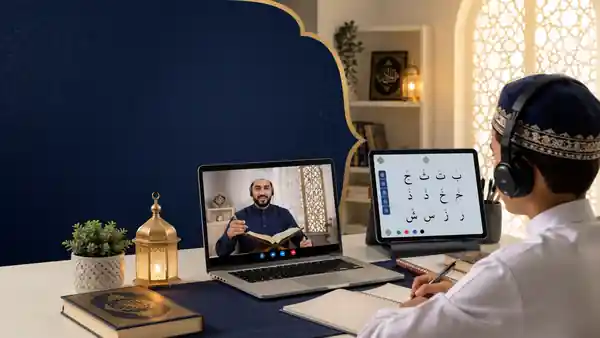
Quick answer
Al Noor Tuition provides live one-to-one online Quran tuition for kids and adults. Students can learn Noorani Qaida, Quran reading, Tajweed, Makharij, Hifz, Arabic and basic Islamic studies with male or female Quran tutor options. Confirm the teacher’s language of explanation, the learner’s starting level and a suitable time zone; families may request a free introductory class before starting.
Every Al Noor Quran student learns at alnoortuition.com/alquran— the complete Noorani Qaida, all 114 surahs with Urdu and English meaning and recitation audio, a children's Islamic library, and a live classroom where teacher and student share one screen. Free, no download, works in any browser.
Free · No app store download · English and Urdu
A student does not need to fit a fixed course. The tutor first identifies the learner’s reading level, pronunciation needs, memorisation goals and preferred pace, then follows the most suitable path.
نورانی قاعدہ
A step-by-step foundation in Arabic letters, sounds, joining, vowels and correct pronunciation for children and complete beginners.
ناظرہ قرآن
Guided Quran reading that builds fluency, confidence, accurate stops and careful pronunciation without rushing the learner.
تجوید و مخارج
Teacher-led correction of articulation points, letter qualities and practical Tajweed rules while the student recites live.
حفظ و دہرائی
A realistic memorisation plan with new lesson, recent revision, long-term revision and regular listening by the tutor.
بڑوں کے لیے قرآن
Respectful, private lessons for adults starting from the alphabet, returning after a gap or improving recitation and Tajweed.
عربی، ترجمہ اور اسلامیات
Age-appropriate vocabulary, selected translation, daily duas and foundational Islamic studies alongside Quran learning.

Noorani Qaida is suitable for young children and adults who need a clear foundation before reading directly from the Quran. The focus is not merely finishing pages; it is recognising letters, producing sounds correctly and building confidence gradually.
نورانی قاعدہ میں صرف سبق مکمل کرنا مقصد نہیں۔ استاد حروف کی پہچان، صحیح آواز، حرکات، جوڑ، سکون، تشدید اور مد کو آہستہ آہستہ پختہ کرتا ہے تاکہ طالب علم قرآنِ کریم پڑھتے وقت اعتماد اور درستگی کے ساتھ آگے بڑھے۔
A tutor confirms this in the first class rather than guessing from a form. These are the starting points we recommend most often, and the pace that tends to hold in practice — not a promise, because a five-year-old and a working adult do not move at the same speed.
Age 4–6, first time near a Qaida
Start with: Noorani Qaida — letters and sounds
Days a week: 3–5
Done when: Recognises every letter by sight, produces each sound correctly, and reads short joined words without help.
Age 7–12, reads a little already
Start with: A short reading assessment, then Nazra
Days a week: 3–5
Done when: Reads a page of the Quran aloud at a steady pace, stopping where the signs say to stop.
Teenager or adult starting from zero
Start with: Qaida one-to-one, privately
Days a week: 2–4
Done when: Reads without spelling each word out, and can follow along in a congregation.
Already reads, wants it correct
Start with: Tajweed and Makharij correction
Days a week: 2–3
Done when: Recitation an ustad would not stop to correct on the basics — letters, lengthening and stopping.
Aiming to memorise
Start with: Hifz, with a written revision plan
Days a week: 5–6
Done when: The memorised portion can be recited from memory weeks later, not only on the day it was learnt.
Wants the meaning as well
Start with: Word-by-word translation alongside Nazra
Days a week: 2–3
Done when: Knows the recurring vocabulary well enough to follow a familiar surah without a translation open.
Two or three days a week is enough to make progress; five or six is what Hifz needs, because memorisation that is not revised almost daily does not stay. Fewer than two days a week, and most of each lesson goes on recovering what was lost since the last one.
Technology should make correction clearer, practice easier and progress more visible. It should not replace the listening, judgement and encouragement of a responsible Quran teacher.
The tutor can listen closely, demonstrate mouth position, enlarge the page and point to the exact letter or word being corrected.
Short practice recordings help students repeat difficult passages and allow the tutor to give focused feedback between lessons when arranged.
Colour highlighting, visual marks and on-screen notes make Tajweed rules and stopping points easier to understand during live teaching.
Regular lesson times, clear homework and revision targets support consistency for schoolchildren, adults and overseas families.
Attendance, completed work, recurring mistakes and the next learning target can be recorded so teaching remains purposeful.
Headphones, slowed repetition and selected model recitations can support practice, while the teacher confirms the final correction.
Automated pronunciation or AI practice tools may support repetition, but they should not be treated as a substitute for a tutor who can hear context, recognise recurring errors and teach with care.
Tajweed is not decoration on top of reading. It is the set of rules that decide which letter you have actually pronounced — and a letter produced from the wrong place in the mouth is a different letter, which can change the meaning of a word. That is why it is taught aloud, with a teacher listening, and why no app alone can finish the job.
Makharij — where each letter is produced
The throat, tongue, lips and nasal passage each produce particular letters. This is the part a student cannot self-correct, because the mistake sounds right from inside your own head.
Sifaat — the qualities of a letter
Whether a letter is heavy or light, whispered or voiced, and whether the sound runs on or stops dead. Two letters from the same place differ only in these.
Rules of noon saakin and tanween
Izhar, idgham, iqlab and ikhfa — when the n sound is pronounced plainly, merged, turned into an m, or hidden with a nasal hum.
Ghunna and qalqalah
The nasal hold on a doubled noon or meem, and the sharp echo on the qutb-jad letters when they carry a sukoon.
Madd — how long to hold a vowel
Natural lengthening and the longer secondary cases. Cutting a madd short or stretching it arbitrarily are both errors, and both are extremely common.
Waqf — where to stop and where not to
The stopping marks in the margin, and the rule that a breath taken in the wrong place can change what a verse appears to say.
Memorisation fails for one reason far more often than any other: new material is added faster than old material is revised. A proper plan divides every session into three parts, and the revision share grows as the student advances — by the time a student has memorised several juz, revision takes longer than the new lesson and should.
Sabaq — the new lesson
A small portion learnt today, recited to the teacher until it is accurate rather than merely approximate. Small and correct beats large and shaky every time.
Sabqi — the recent revision
Everything from roughly the last week, or the current juz, recited again. This is the part students quietly skip, and it is the part that decides whether the new lesson survives.
Manzil — the long-term revision
A rotating portion of everything already memorised, on a schedule that brings each juz back round regularly rather than whenever it is remembered.
A realistic pace for a school-going child is a quarter page to a page of new memorisation a day, five or six days a week, alongside revision. Anyone promising a juz a month to a nine-year-old with two lessons a week is describing something that will be forgotten by the following term.
You do not need to know Tajweed yourself to judge this. Sit in on one lesson — a free trial is the right moment — and watch for six things.
01
For most of the lesson it should be the student. A teacher who recites beautifully while the child listens is performing, not teaching.
02
Good teaching notices that this is the third time the same letter has slipped and treats it as a pattern, not as three unrelated slips.
03
“Again” is not teaching. “That is a heavy letter, so the tongue goes back — listen” is. A teacher who cannot name the rule usually cannot fix it either.
04
What was covered, what went wrong, and what to practise before next time. Without it, week two starts from nowhere and parents are guessing.
05
A child who is tired, shy or stuck needs today’s lesson adjusted. A teacher marching through a fixed page count is teaching the syllabus at your child, not to them.
06
Ask for a free introductory class and listen to the teacher recite before you commit to a month. Any serious teacher expects to be heard first.
You receive the teacher’s profile before the first class rather than after it. Lessons run inside our own classroom, so there is a record of who taught what and when, and a parent is welcome in the room or on the call for as long as they want. Teacher and family message each other through our platform rather than a private number, which means nothing important lives only in somebody’s phone — and a teacher who is not working out is replaced without you having to negotiate it.
Most of our overseas Quran students are Pakistani families who want their children reading properly in Arabic and holding on to Urdu at the same time. Teaching runs on Pakistan Standard Time, which lines up conveniently with the Gulf and after-school hours in the UK, and with early mornings or evenings further west.
UAE & Dubai
One hour behind Pakistan — after-school and after-Maghrib slots both work.
Online tutors for this region →Saudi Arabia
Two hours behind Pakistan; early-evening classes are the easiest fit.
Online tutors for this region →United Kingdom
Pakistan evenings land in the UK afternoon, straight after school.
Online tutors for this region →USA & Canada
Early Pakistan mornings are US evenings — the most requested slot for children.
Online tutors for this region →Qatar, Kuwait, Bahrain, Oman and Australia are all taught too — tell us your city and the hours that work and we will match a teacher who is genuinely free at that time rather than one who will cancel by the third week.
Live one-to-one Quran lessons for children and adults. Begin with Noorani Qaida or a reading assessment, then follow a clear plan for recitation, Tajweed, Hifz and revision.
بچوں اور بڑوں کے لیے انفرادی آن لائن قرآن کلاسز۔ نورانی قاعدہ، ناظرہ، تجوید، مخارج، حفظ اور بنیادی اسلامیات ایک واضح منصوبے کے مطابق پڑھائی جاتی ہیں۔ استاد ہر سبق میں تلاوت سنتا ہے، غلطی کی اصلاح کرتا ہے اور اگلے سبق کے لیے مختصر مشق دیتا ہے۔
دروس فردية مباشرة لتعلّم القرآن الكريم للأطفال والكبار، تبدأ من الحروف والقاعدة النورانية، ثم القراءة والتجويد ومخارج الحروف والحفظ والمراجعة. يستمع المعلّم إلى التلاوة، ويصحّح الأخطاء، ويضع خطة مناسبة لمستوى الطالب ووقته.
Suitable for families across Pakistan and overseas, with flexible timings, no travel and access through phone, tablet or laptop.
Request a male or female tutor, preferred explanation language and lesson schedule. Matching depends on the learner’s level and availability.
Request a female Quran tutor →In-person Quran tuition may be arranged in selected areas. Share your city, locality, tutor preference and suitable time for an availability check.
Quran tutors in Lahore →Ready to enrol? Monthly fees, course lengths and what each plan includes are set out on the online Quran classes programme page.
Tell us the age, current reading ability, goals and whether the learner needs Qaida, Nazra, Tajweed or Hifz.
Select online or home tuition, male or female tutor, preferred language, days and suitable time.
Attend an introductory or trial class so the tutor can assess the learner and recommend a realistic plan.
Continue with scheduled lessons, practice, revision and progress feedback through a consistent learning routine.
Every Al Noor student learns in our own Quran classroom at alnoortuition.com/alquran. It is free, needs no download, and runs in any browser on a phone, tablet or laptop. Tutor and student share one screen — the Noorani Qaida board, any of the 114 surahs, or a book from the teaching library — with a shared writing board, highlighting, live video and recitation audio.
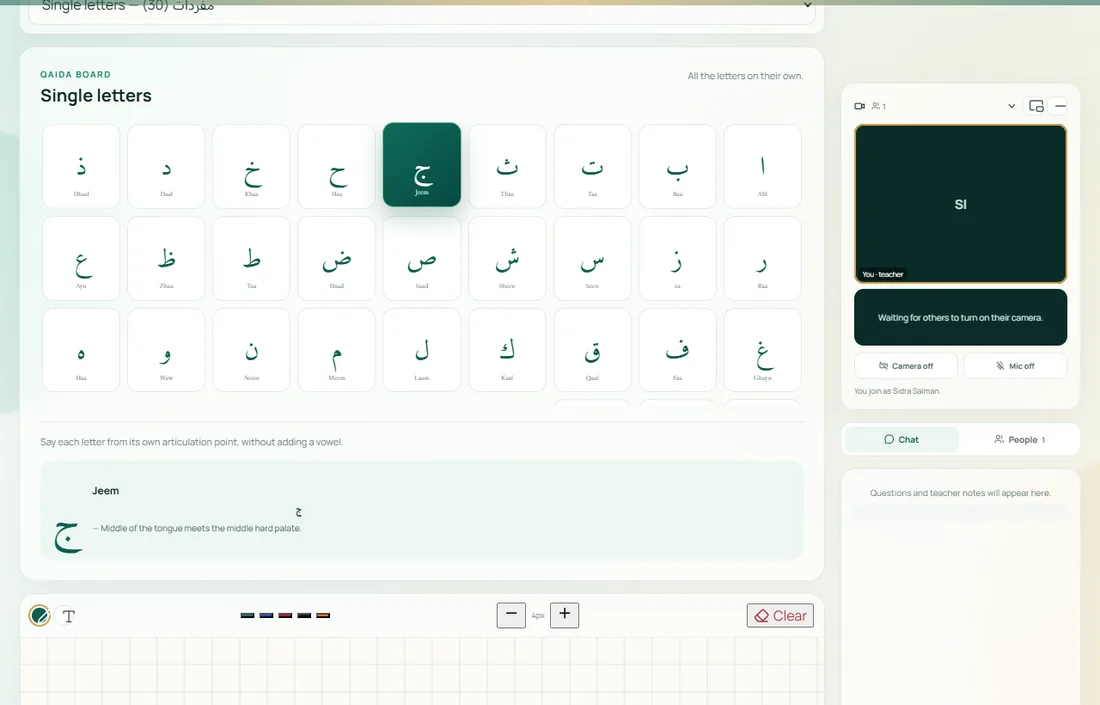
The teacher spotlights a letter and every student sees it at the same moment, with the makhraj written underneath.
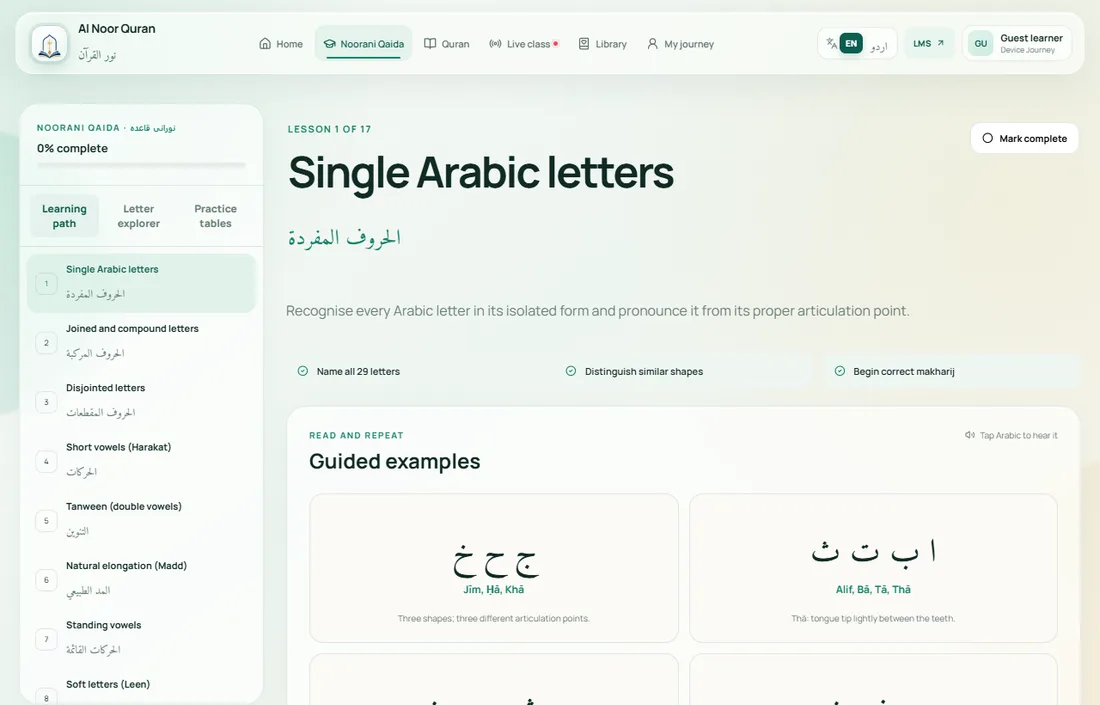
Seventeen guided stages plus full practice boards — single letters, joining, harakat, tanween, madd and tajweed.
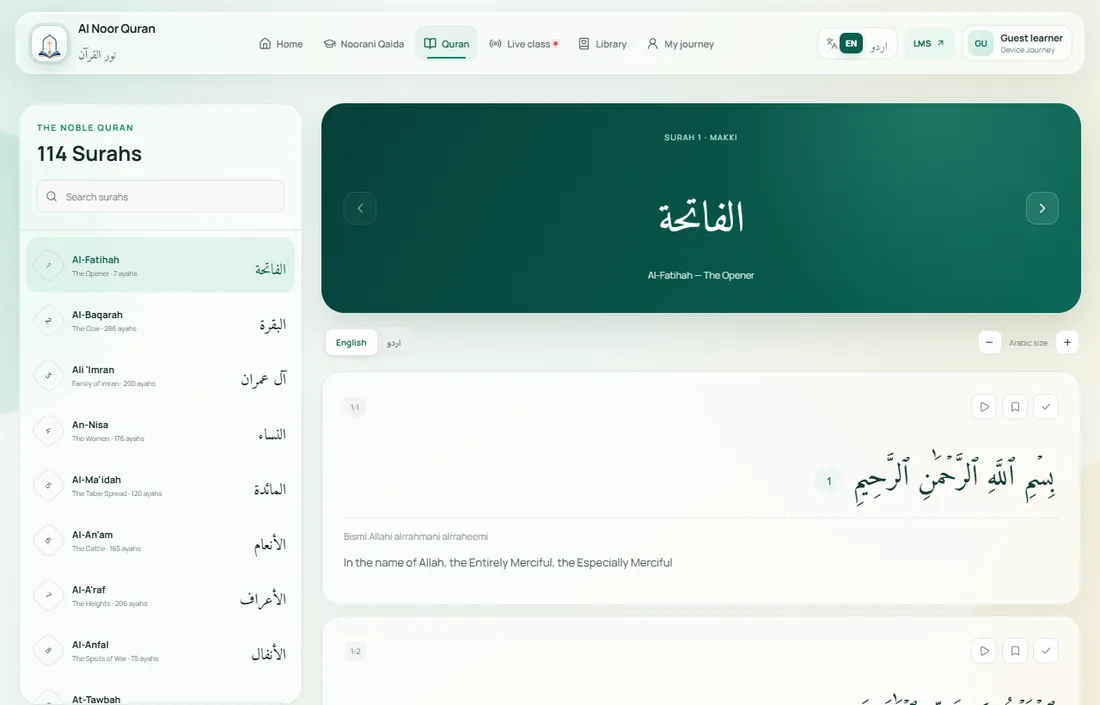
All 114 surahs with Uthmani script, Urdu and English meaning, per-ayah recitation, bookmarks and your last-read position.
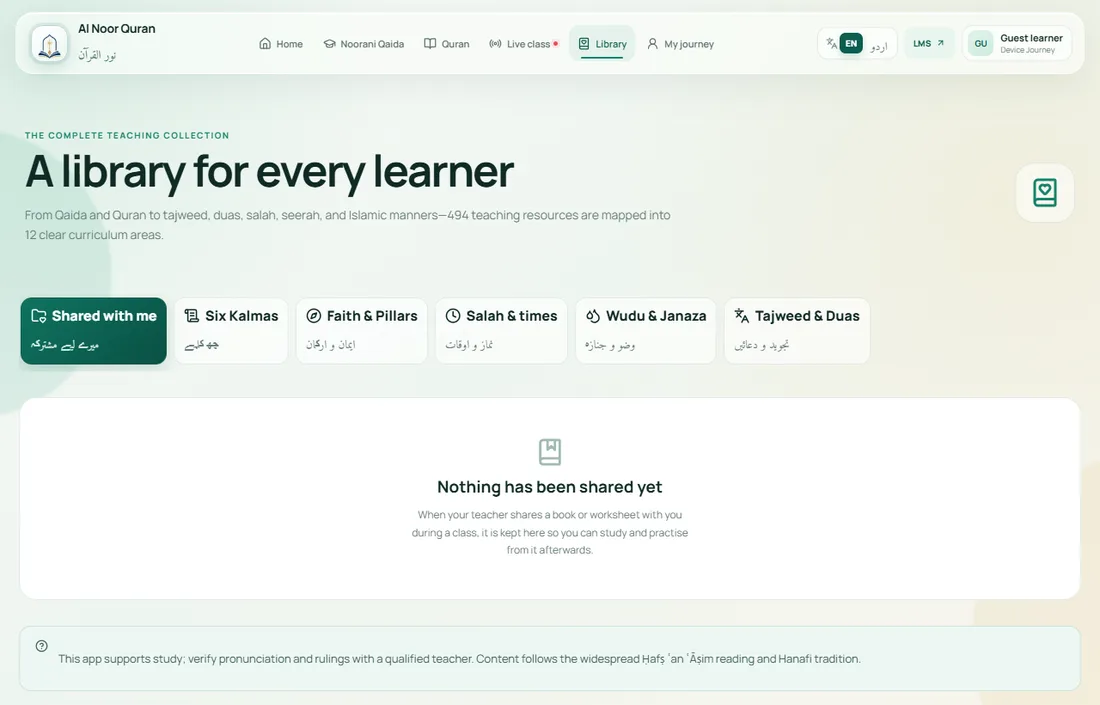
Six Kalmas, daily duas, salah and wudu, tajweed rules and prayer times — plus the teaching archive your tutor draws from.
Teacher and student read the same page in real time — Qaida board, ayah, or a book from the library.
A shared board that takes handwriting and typed Arabic, Urdu or English, so a correction is drawn where the mistake is.
The tutor highlights the exact word on the exact page, and it lands on that word on every device.
Tap any letter or ayah to hear it, with the articulation point explained in English or Urdu.
Amiri, Scheherazade, Noto Naskh, Lateef, Reem Kufi and Nastaliq — the tutor picks what the class reads in.
The tutor sets the language of the lesson, so every child is reading the words the teacher is saying.
A tutor awards a star mid-lesson and the whole class sees it — encouragement at the moment it is earned.
Video that can float, resize or tuck away, so a small phone screen still shows the lesson first.
What a class covers is recorded against the learner, so revision after the lesson picks up where the tutor left off.
Rooms are opened by verified tutor accounts, and study material is released to a child by their teacher.
Free to use · No app store download · Works on any browser · English and Urdu
Online Quran tuition is live teaching: the teacher listens to the learner and corrects reading, pronunciation or memorisation. A recitation recording or a Quran app is useful practice, but it cannot replace a teacher hearing the particular mistake a learner makes.
When arranging Quran online tuition, share the learner’s age, reading level, preferred teaching language, teacher preference and local time zone. Explain whether the goal is to start Qaida, improve Tajweed or memorise with revision. A family seeking a female Quran teacher should confirm availability before agreeing to a timetable.
Ask the learner to recognise a few letters and read short combinations. The teacher should identify whether letter recognition, joining or vowel sounds need attention before assigning a longer passage.
Listen to a short passage, note recurring pronunciation and stopping errors, and choose a manageable correction target. Finishing more pages is not the same as reading them accurately.
Check the new passage and an older memorised passage. Agree how new learning, recent revision and older revision will share the lesson. A page count without retention is a weak progress measure.
Before booking, confirm session length, weekly frequency, the monthly fee and missed-class arrangements. See the Quran programme and current fees, practise with the free Quran learning app, or read how to choose a Pakistani online teacher.
Online Quran tuition is live teaching over an internet connection. The teacher listens to the learner and gives individual correction for Qaida, Quran reading, Tajweed or Hifz. The starting level, teaching language, teacher preference and schedule should be agreed before regular lessons.
Ask the teacher to demonstrate recitation and explain a correction clearly. Match their experience to the learner’s level, confirm the teaching language and use a trial to check attention, communication and a realistic revision plan. Nationality alone does not establish teaching quality.
Yes. Al Noor Quran is free at alnoortuition.com/alquran, needs no download and runs in any browser on a phone, tablet or laptop. It includes the complete Noorani Qaida with practice boards, all 114 surahs with Urdu and English meaning and recitation audio, a children’s Islamic library, and a live classroom where tutor and student share one screen with a writing board, highlighting and video.
Tutor and student see the same screen. The tutor puts a Noorani Qaida board, an ayah, or a page from the teaching library up, spotlights the exact letter or word being taught, and can highlight and write on it in Arabic, Urdu or English. The student hears each letter, follows on their own device, asks questions in chat, and what the class covered is saved to their progress for revision afterwards.
Lessons are live and usually one-to-one. The tutor listens to the student, shares the Quran or Noorani Qaida on screen when useful, corrects pronunciation, records progress and gives a short practice task before the next class.
They can be very effective when lessons are live, short, consistent and adapted to the child. A tutor can hear each letter, repeat difficult sounds, use visual annotation and keep parents informed about attendance and progress.
Yes. Families can request a female Quran teacher for girls, women or young children, subject to schedule and tutor availability. Male Quran tutors and Qari options are also available.
Yes. Adults may start with Noorani Qaida, an initial reading assessment or direct Tajweed correction. Lessons are private and paced according to the learner’s confidence, work schedule and previous experience.
Noorani Qaida lessons normally progress from Arabic letters and their sounds to short vowels, joining, sukoon, tashdeed, madd and guided word reading. The goal is a strong transition into Quran reading with correct pronunciation.
Yes. The tutor listens to your live recitation and works on Makharij, letter qualities and practical Tajweed rules. Digital highlighting and replay can support practice, but final correction remains teacher-led.
Yes. Hifz support can include a new memorisation target, recent revision, long-term revision and listening sessions. The plan is adjusted to the student’s age, retention and available study time.
Tutor matching can consider English, Urdu and Arabic support. Tell us the learner’s preferred explanation language when submitting the tutor request.
A free introductory or trial session can be arranged so the learner can meet the tutor, confirm the level and understand the recommended plan before regular paid lessons begin.
Home Quran tuition may be available in selected Pakistani cities. Submit your city, area, preferred tutor gender and schedule through the tutor request form, and the team will confirm local availability.
A smartphone, tablet or laptop with headphones and a stable internet connection is usually enough. A quiet learning space and a printed Quran or Qaida are also helpful.
For a child having three to five short lessons a week, the Qaida usually takes a few months rather than a few weeks — commonly two to four. Adults working one-to-one often move faster through letter recognition and slower through pronunciation. Finishing the book is not the goal in itself: the goal is reading joined words correctly without help, and a tutor who rushes a child to the last page has left the work undone.
Two or three days a week is enough to make steady progress on Qaida, Nazra or Tajweed. Hifz needs five or six, because memorisation that is not revised almost daily does not hold. Below two days a week most of each lesson goes on recovering what was lost since the last one, which is why we would rather suggest shorter, more frequent classes than long, rare ones.
One-to-one for Qaida, Tajweed correction and Hifz, because all three depend on the teacher hearing one voice clearly and correcting it in the moment. A small group can work for translation, Islamic studies or siblings at genuinely the same level. Where a group is suggested only to reduce the fee, the child who is behind is the one who pays for it.
Yes, where they are close in level as well as age, and many families do this. Where one child reads fluently and the other is still on letters, a shared slot means one of them is being taught at the wrong level for half the lesson, so we would rather split the sessions and say why.
Tell the teacher through the platform and the slot can usually be moved rather than lost, subject to their other commitments. Because lessons and progress notes are recorded, a missed week does not mean starting the topic again — the student can rewatch what was covered before the next class.
Teaching runs on Pakistan Standard Time and we schedule around your local hours. The Gulf is within an hour or two, so after-school and after-Maghrib slots both work. Pakistan evenings land in the UK afternoon; Pakistan mornings are US and Canadian evenings, which is the most-requested slot for children there. Australia is usually taught in the Pakistan morning.
Yes, and it is one of our commonest adult requests. It starts with the teacher listening to you recite and writing down what is actually happening — usually a small number of recurring errors in Makharij, madd length and stopping, not a general vagueness. Two or three sessions a week for a few months changes it noticeably. Nothing about this requires going back to the Qaida.
Every session is split three ways: sabaq, the new portion; sabqi, roughly the last week or the current juz; and manzil, a rotating share of everything already memorised. The revision share grows as the student advances, and past a few juz revision should take longer than the new lesson. A plan that only tracks new memorisation is the usual reason a student who once knew ten juz can no longer recite three.
Yes — word-by-word translation and selected Tafseer for older students, alongside daily duas and foundational Islamic studies. Recurring Quranic vocabulary is a small enough set that a teenager who learns it can follow a familiar surah without a translation open, which changes the experience of reading entirely.
Yes, and privately. Lessons begin with the Arabic letters and their sounds, at whatever pace suits, with the prayer-related surahs prioritised if that is what you need first. Teaching is one-to-one, so nobody is watching and there is nothing to be embarrassed about.
Short lessons — twenty to thirty minutes — more often, with a parent nearby for the first few until the child settles. We match on temperament as well as qualification for young children, because patience and warmth matter more at that stage than how much Tajweed a teacher knows. If it is not working with a particular teacher, say so and we change teacher rather than asking the child to adapt.
Monthly course fees are listed on our online Quran classes programme page. The exact fee depends on lesson frequency, duration, level and whether the arrangement is online or at home, and is confirmed before regular classes start.
Published by Al Noor Tuition. Content updated . For a correction or a question about your child’s syllabus, contact our team.
Complete the short form and our advisor will shortlist suitable teachers for your class, subjects, location, and preferences.
Easy steps · about two minutes
Join hundreds of families across Pakistan who have found trusted, verified home and online tutors through Al Noor Tuition.
No obligation·Free advisor consultation·24–48 hour response
Complete the short form and our advisor will shortlist suitable teachers for your class, subjects, location, and preferences.
Easy steps · about two minutes