Pakistan · HEC Education Testing Council
LAT preparation for LLB admission in Pakistan
Every LLB applicant in Pakistan needs at least 50% in HEC’s Law Admission Test. It covers English, Urdu, general knowledge, Pakistan Studies, Islamiat and a little mathematics, then asks for an essay and a personal statement.
Quick answer
The Law Admission Test (LAT) is HEC’s entry test for the LLB, run by its Education Testing Council. HEC’s 2025 LLB curriculum makes a LAT score of at least 50% mandatory for admission, alongside at least 45% in HSSC, A Level or an IBCC equivalent. Part I has 75 MCQs in 100 minutes: English 20, General Knowledge 20, Pakistan Studies 10, Islamiat 10, Mathematics 5 and Urdu 10. Part II, in 40 minutes, is an essay (15 marks) and a personal statement (10 marks), in English or Urdu. HEC held it five times in 2026.
Who has to take LAT
HEC notified a revised LLB curriculum on 10 July 2025, effective from Fall 2025, which shortens the LLB from five years to four. Its eligibility rule has two parts: the Higher Secondary School Certificate, A Levels or an IBCC equivalent with at least 45% marks, and a score of at least 50% in the LAT conducted by HEC’s Education Testing Council.
HEC’s content outline opens the test to anyone with twelve years of education, or the equivalent, in any discipline, so FSc, FA, ICS, ICom and A Level students can all sit it. HEC’s curriculum committee also decided that there is no upper age limit for the LLB, and that a gap after Class 12 is no reason to refuse a student who has cleared LAT.
The LAT pattern: sections, marks and time
HEC’s published content weightages split the test into two parts, each with its own time limit. English and general knowledge together make up 40 of the 75 MCQs, more than half of Part I, so they deserve the most practice.
- Part I, 100 minutes, 75 MCQs: English 20, General Knowledge 20, Pakistan Studies 10, Islamiat 10, Mathematics 5 and Urdu 10.
- Part II, 40 minutes: an essay on one of three topics, in English or Urdu (15 marks), and a personal statement in English or Urdu (10 marks).
The 50% pass mark
A score of 50% is the minimum HEC sets for LLB admission. It makes you eligible to apply; it does not by itself give you a place, so read each university’s admission notice for how it fills its seats.
Part II carries 25 marks, so practise the essay and the personal statement as seriously as the MCQs.
When LAT is held, and how to register
HEC’s Education Testing Council published five LAT dates for 2026: 25 January, 12 April, 21 June, 6 September and 15 November. Registration is online, on the ETC portal at etc.hec.gov.pk, and closed three to four weeks before each test; roll number slips are issued on the same portal before the test day.
Results came about six weeks after each test: the November 2026 sitting’s result was scheduled for 24 December. HEC publishes each year’s calendar on the ETC pages, and the 2027 dates were not out when we checked on 18 November 2026.
HEC advises candidates under 18 who do not have a Juvenile Card to get one from NADRA before the test date, because it must be shown at the test centre.
The essay and the personal statement
You choose one essay topic out of three and write it in English or Urdu, then write a personal statement, all in 40 minutes. Pick the language you write more accurately in, not the one you think will impress. A clear essay has an introduction that answers the question, two or three paragraphs that each make one point with an example, and a short conclusion.
The personal statement is about you: why law, what has prepared you for it, and what you want to do with it. Draft one at home, have it corrected, and practise writing it again from memory in about fifteen minutes, so the essay keeps most of the time.
Preparing for the MCQs
English carries 20 questions, so build grammar and vocabulary every week. General Knowledge carries another 20, and it is the section most often left too late: read a newspaper every day for current affairs and keep short notes. Pakistan Studies and Islamiat, 10 questions each, draw on what you studied at school, so revise them from your own books.
Urdu has 10 questions and Mathematics 5. Mathematics is a small share of the paper, so revise the basics rather than a whole syllabus, and give the time you save to general knowledge.
LAT is not Law-GAT
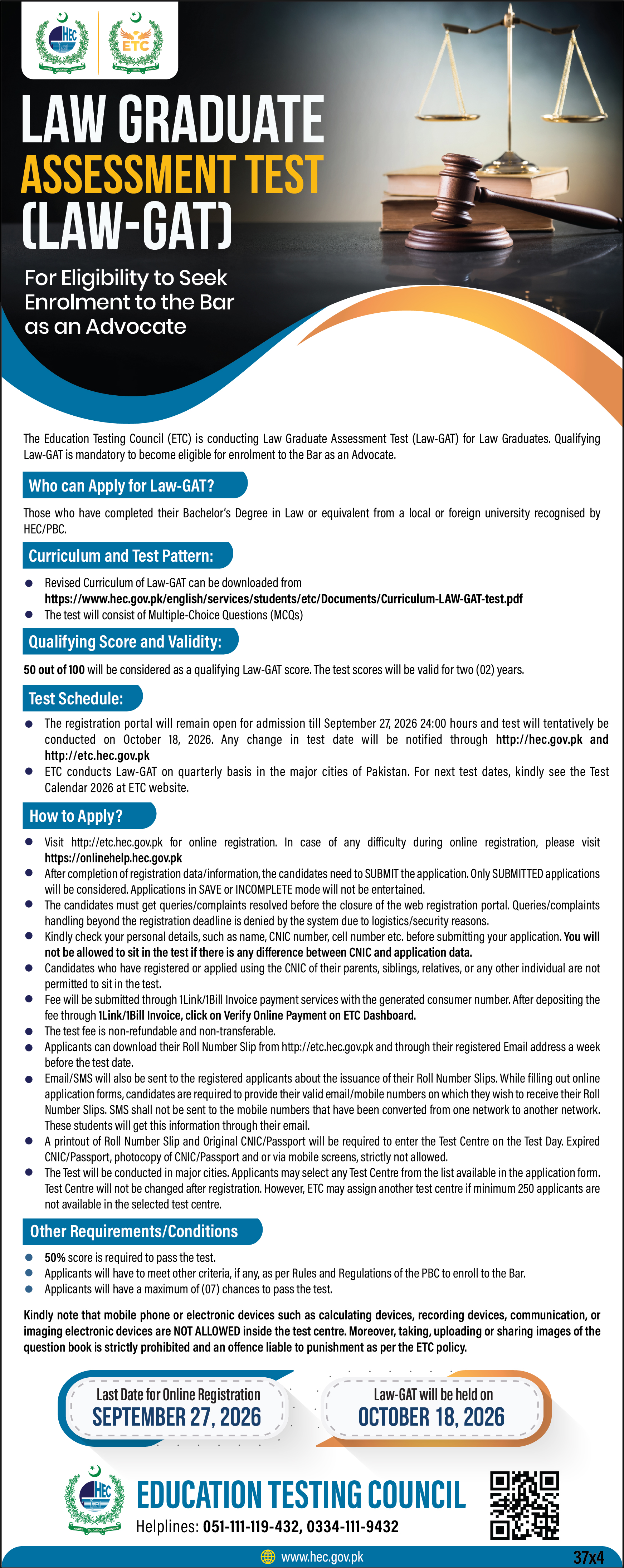
The Law Graduate Assessment Test (Law-GAT) comes at the other end of the degree. HEC’s Education Testing Council runs it for law graduates, and qualifying it is mandatory to become eligible for enrolment at the Bar as an advocate. It is a multiple-choice test, 50 out of 100 qualifies, and scores are valid for two years. HEC’s 2026 calendar listed four Law-GAT sittings.
The request form lists LAT and Law-GAT separately under Entry Test Prep, so choose the one you are sitting.
A study plan, and help from a tutor
Give yourself eight to twelve weeks if you can. Spend the first weeks on general knowledge and English, write one timed essay and one personal statement each week, and sit a full timed paper, both parts, every two weeks.
LAT tutoring is matched on request. In the request form, choose Entry Test Prep as the level and LAT as the subject, then tell us your test date and whether you will write in English or Urdu. An advisor will confirm a tutor’s experience before you agree to lessons, and you can start with a free 20-minute demo class. If no suitable tutor is free, we will say so.
Related guides and programmes
Questions about this tuition route
What is the passing score in LAT?
At least 50%. HEC’s LLB curriculum makes a 50% LAT score mandatory for admission, along with at least 45% in HSSC, A Level or an IBCC equivalent.
How many MCQs are in the LAT?
75, in 100 minutes: English 20, General Knowledge 20, Pakistan Studies 10, Islamiat 10, Mathematics 5 and Urdu 10. A written part follows, with an essay and a personal statement in 40 minutes.
Can I write the LAT essay in Urdu?
Yes. HEC’s outline allows the essay and the personal statement in English or Urdu. You choose one essay topic out of three.
How many times a year is LAT held?
HEC’s Education Testing Council held it five times in 2026, in January, April, June, September and November. Check the ETC portal for the next date and its registration deadline.
Who can sit the LAT?
Anyone with twelve years of education, or the equivalent, in any discipline. To be admitted to an LLB you also need at least 45% in HSSC, A Level or an IBCC equivalent.
Is LAT the same as Law-GAT?
No. LAT is for admission to the LLB. Law-GAT is for law graduates: qualifying it is mandatory to become eligible for enrolment at the Bar as an advocate.
How long is a LAT result valid?
The HEC documents we checked on 18 November 2026 do not state a validity period for LAT, so confirm it with the Education Testing Council and with each university before you rely on an older result.
Can I prepare for LAT from abroad?
Yes. Lessons are online and one-to-one, at a time that suits your time zone. Check the test centres on the ETC portal when you register.
How much does LAT preparation cost?
Families outside Pakistan pay USD 9–30 an hour, set by each tutor, and can start with a free 20-minute demo class before committing. In Pakistan, tuition is quoted by the month and by class; our fee guide gives the current ranges.
Published by Al Noor Tuition. Content updated . For a correction or a question about your child’s syllabus, contact our team.
Official sources to check your exam route
- HEC: content weightages for the Law Admission Test (checked 18 November 2026)
- HEC: revised curriculum of the four-year LLB (July 2025) (checked 18 November 2026)
- HEC Education Testing Council: test calendar 2026 (checked 18 November 2026)
- HEC Education Testing Council: announcements (checked 18 November 2026)
- HEC Education Testing Council: Law-GAT advert (checked 18 November 2026)
Use the syllabus and entry requirements for your exam year. These sources do not imply an affiliation or endorsement.
Ready to Find the Right Tutor for Your Child?
Tell us what your child needs and we will match you with a verified tutor: online wherever you live, or at home in selected cities in Pakistan.
No obligation·Free advisor consultation·24–48 hour response