Pakistan · NTS GAT and HEC’s HAT
GAT and HAT preparation for MS, MPhil and PhD admission
An MS, MPhil or PhD place in Pakistan comes with an admission test. Find out which test your university accepts, sit the right category, and practise verbal, quantitative and analytical questions against the clock.
Quick answer
NTS’s Graduate Assessment Test comes in two forms. GAT General, for MS and MPhil admission, has 100 MCQs in 120 minutes of verbal, quantitative and analytical reasoning; GAT Subject, for PhD admission, has 100 MCQs in 120 minutes, 70% of them on your subject. Both results are valid for two years. HEC’s own test is the HAT, in five categories. HEC’s Graduate Education Policy 2023 sets the admission-test passing score at 50% for MS and MPhil and 60% for PhD.
GAT General, GAT Subject or HAT?
NTS describes GAT General as the test for MS and MPhil admission, open to anyone with at least sixteen years of education, and GAT Subject as the test for PhD programmes, open to anyone with at least eighteen. HEC’s Education Testing Council runs the Higher Education Aptitude Test (HAT) for MS, MPhil and PhD admission at the universities that accept it, and HAT results also count for HEC scholarships.
Universities choose which tests they accept, so start with the admission notice of each programme you are applying to. HEC’s policy also allows a university to set its own admission test, at the same passing score.
GAT General: four categories, three sections
GAT General has 100 multiple-choice questions in 120 minutes, on paper. Every category tests the same three things, verbal, quantitative and analytical reasoning, in different proportions. Choose the category that matches your field from NTS’s list of eligible disciplines, which does not follow faculty names exactly: statistics, for example, appears under both GAT-B and GAT-C.
Calculators, mobile phones and watches with calculators are not allowed in the test centre. NTS puts two blank sheets for rough work inside the question booklet.
- GAT-A, for business and engineering: verbal 35%, quantitative 35%, analytical 30%.
- GAT-B, for arts, humanities and social sciences: verbal 50%, quantitative 30%, analytical 20%.
- GAT-C, for agricultural, veterinary, biological and related sciences (NTS’s list of eligible fields also places medicine, the physical sciences, mathematics and computing here): verbal 45%, quantitative 35%, analytical 20%.
- GAT-D, for religious studies students from a madrassa background with HEC equivalence: verbal 50%, quantitative 30%, analytical 20%.
GAT Subject: 70% on your own subject
GAT Subject also has 100 MCQs in 120 minutes, on paper. The general part is 30% of the paper, English (verbal) 15% and analytical reasoning 15%, and the other 70% tests your subject. NTS publishes a curriculum and paper distribution for each subject, more than fifty of them, from Arabic and agriculture to physics and psychology.
Read your subject’s curriculum before anything else. It tells you which areas the 70% is drawn from, which is the difference between revising a whole degree and revising for the test.
HEC’s HAT: five categories
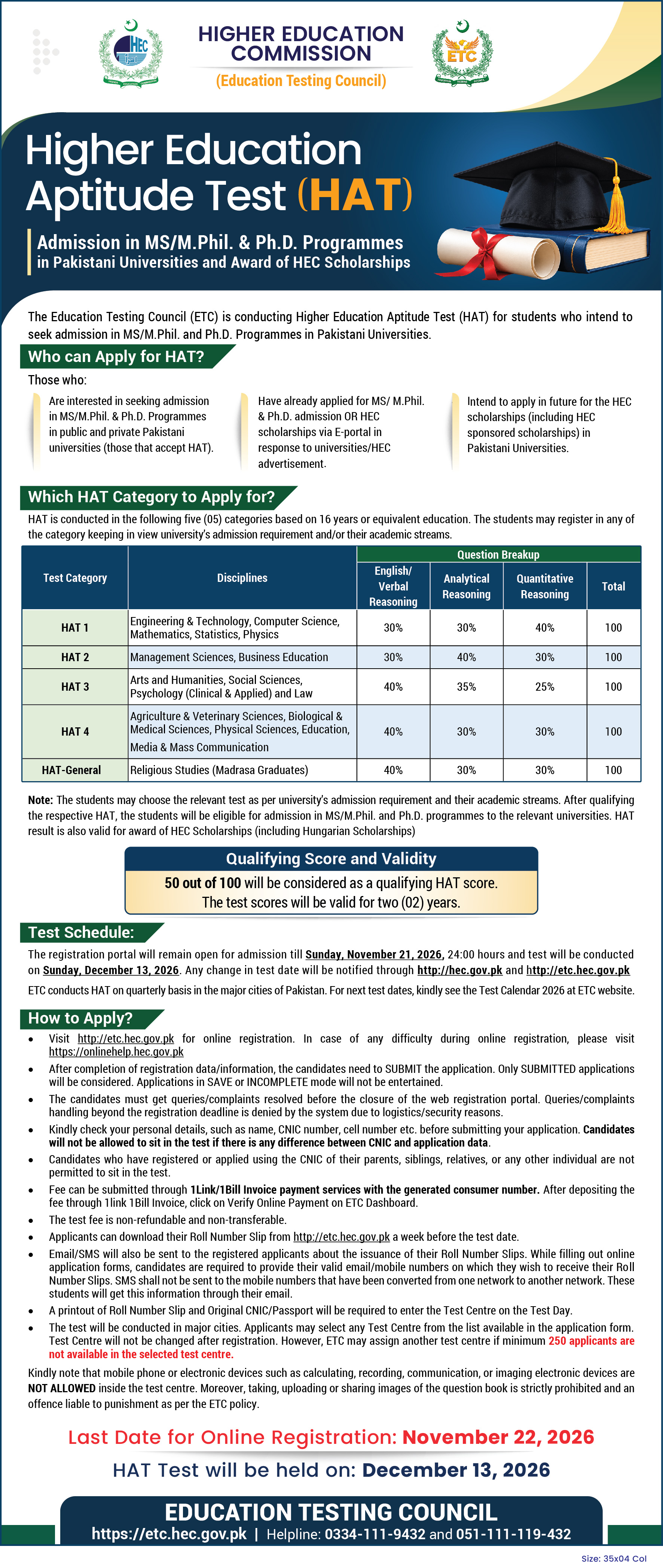
HAT is run by HEC’s Education Testing Council, and you register on its portal, etc.hec.gov.pk. Its five categories are based on sixteen years of education, and each mixes English or verbal reasoning, analytical reasoning and quantitative reasoning in its own proportions. HEC treats 50 out of 100 as a qualifying HAT score, and results are valid for two years.
HEC’s 2026 calendar listed five HAT sittings, in February, April, July, October and December. HEC also publishes sample papers by category, and they are the best guide to the question types: sentence completion, sentence correction, analogies and antonyms in the verbal section, puzzles built on a set of rules in the analytical section, and word problems in the quantitative one.
- HAT 1, for engineering and technology, computer science, mathematics, statistics and physics: English or verbal reasoning 30%, analytical 30%, quantitative 40%.
- HAT 2, for management sciences and business education: English or verbal reasoning 30%, analytical 40%, quantitative 30%.
- HAT 3, for arts and humanities, social sciences, psychology (clinical and applied) and law: English or verbal reasoning 40%, analytical 35%, quantitative 25%.
- HAT 4, for agriculture and veterinary sciences, biological and medical sciences, physical sciences, education, and media and mass communication: English or verbal reasoning 40%, analytical 30%, quantitative 30%.
- HAT-General, for religious studies (madrasa graduates): English or verbal reasoning 40%, analytical 30%, quantitative 30%.
The scores HEC requires: 50% for MS and MPhil, 60% for PhD
HEC’s Graduate Education Policy 2023, in force since Fall 2023, sets the minimum. For MS and MPhil, a university must either run a rigorous admission test with a passing score of 50% or accept the GRE, HAT General or an equivalent test at 50%. For a PhD the passing score is 60%, on a test equivalent to the GRE or HAT General, whether the university sets it or accepts one from a testing body HEC has accredited. A university may add a subject test for PhD admission.
Those are floors: HEC says a university may raise its standards but not lower them. Note the gap for PhD applicants. HEC’s HAT advert calls 50 out of 100 a qualifying score, but the policy asks for 60% for PhD admission, so aim for at least 60 and read the university’s notice.
Two more rules are worth knowing. PhD admission also needs a CGPA of at least 3.0 out of 4.0, or 60% in the annual system, in the MS or MPhil degree, with a route of extra coursework for those below it. And changing to a different discipline within the same broad field needs a GRE Subject or equivalent test with at least 50%, plus deficiency courses.
How long scores last, and how often the tests run
NTS says GAT General and GAT Subject results stay valid for two years, a rule in force since 1 January 2007, and you can sit again to improve a score. In 2026 NTS scheduled GAT General eight times and GAT Subject six times, with registration on its online portal. HAT scores are valid for two years as well.
NTS uploads roll number slips at least seven days before a test, and HEC issues HAT slips on the ETC portal about a week ahead. When you apply to a university, send the result card in the way its admission notice asks.
How to prepare for GAT and HAT
Start with a timed sample paper in your category, then sort every wrong answer by its cause: a word you did not know, a grammar rule, a puzzle you could not set up, or arithmetic you rushed. Verbal reasoning grows with daily reading and a vocabulary notebook. Analytical reasoning improves fastest when you draw each puzzle’s rules as a diagram before answering. Practise quantitative reasoning without a calculator, because neither NTS nor HEC allows one.
- First week: one timed sample paper in your category, and a list of your wrong answers by type.
- Every day: English reading, with new words in a notebook.
- Every week: timed sets in your weakest section.
- Every two weeks: a full paper in your category, against the clock.
- For GAT Subject: your subject’s NTS curriculum, worked through topic by topic.
Help from a tutor
GAT and HAT tutoring is matched on request. In the request form, choose Entry Test Prep as the level and GAT General, GAT Subject or HAT as the subject, then tell us your category, your test date and the section that costs you most. An advisor will confirm a tutor’s experience before you agree to lessons, and you can start with a free 20-minute demo class. If no suitable tutor is free, we will say so.
Lessons are online, so you can prepare from anywhere. The tests themselves are held at centres in Pakistan.
Related guides and programmes
Questions about this tuition route
What is the passing score for GAT General?
HEC’s Graduate Education Policy 2023 sets 50% as the passing score on the admission test for MS and MPhil. Universities can ask for more, so check each admission notice.
What score do I need for PhD admission?
60%, under HEC’s Graduate Education Policy 2023, on a test equivalent to the GRE or HAT General, whether the university sets it or accepts one from an HEC-accredited testing body. A university may also set a subject test.
How many questions are in the GAT, and how long is it?
GAT General and GAT Subject each have 100 multiple-choice questions in 120 minutes, on paper.
How long is a GAT result valid?
NTS says GAT General and GAT Subject results are valid for two years. HEC’s HAT results are also valid for two years.
Is HAT the same as GAT?
No. GAT is set by NTS and HAT by HEC’s Education Testing Council. Both test verbal, quantitative and analytical reasoning for graduate admission, but the categories and weightings differ, and each university decides which it accepts.
Which GAT category should I choose?
The one that matches the discipline you are applying to, from NTS’s list of eligible fields: GAT-A for business and engineering, GAT-B for arts, humanities and social sciences, GAT-C for the sciences, including agriculture, medicine and computing, and GAT-D for religious studies graduates with HEC equivalence. If a university names a category, sit that one.
Can I prepare for GAT from abroad?
Yes. Lessons are online and one-to-one, at a time that suits your time zone. The tests are held at centres in Pakistan, so plan your travel around the test date.
How much does GAT preparation cost?
Families outside Pakistan pay USD 9–30 an hour, set by each tutor, and can start with a free 20-minute demo class before committing. In Pakistan, tuition is quoted by the month and by class; our fee guide gives the current ranges.
Do you have GAT tutors?
We match GAT and HAT candidates on request. Tell us your category, your test date and your weakest section, and an advisor will confirm a tutor’s experience before you agree to lessons. If no suitable tutor is free, we will say so.
Published by Al Noor Tuition. Content updated . For a correction or a question about your child’s syllabus, contact our team.
Official sources to check your exam route
- NTS: GAT General (checked 18 November 2026)
- NTS: GAT General paper distribution and eligible fields (checked 18 November 2026)
- NTS: GAT Subject (checked 18 November 2026)
- NTS: GAT Subject paper distribution and curricula (checked 18 November 2026)
- HEC: Graduate Education Policy 2023 (checked 18 November 2026)
- HEC Education Testing Council: HAT advert, November 2026 (checked 18 November 2026)
- HEC Education Testing Council: test calendar 2026 (checked 18 November 2026)
- HEC Education Testing Council: HAT sample papers (checked 18 November 2026)
Use the syllabus and entry requirements for your exam year. These sources do not imply an affiliation or endorsement.
Ready to Find the Right Tutor for Your Child?
Tell us what your child needs and we will match you with a verified tutor: online wherever you live, or at home in selected cities in Pakistan.
No obligation·Free advisor consultation·24–48 hour response